
Field guide · Sourcing
Shenzhen EV Sourcing Playbook
Find, vet and buy from Chinese EV charger, storage and power-technology factories.
EV Ecosystem Library · Reference · Fleets
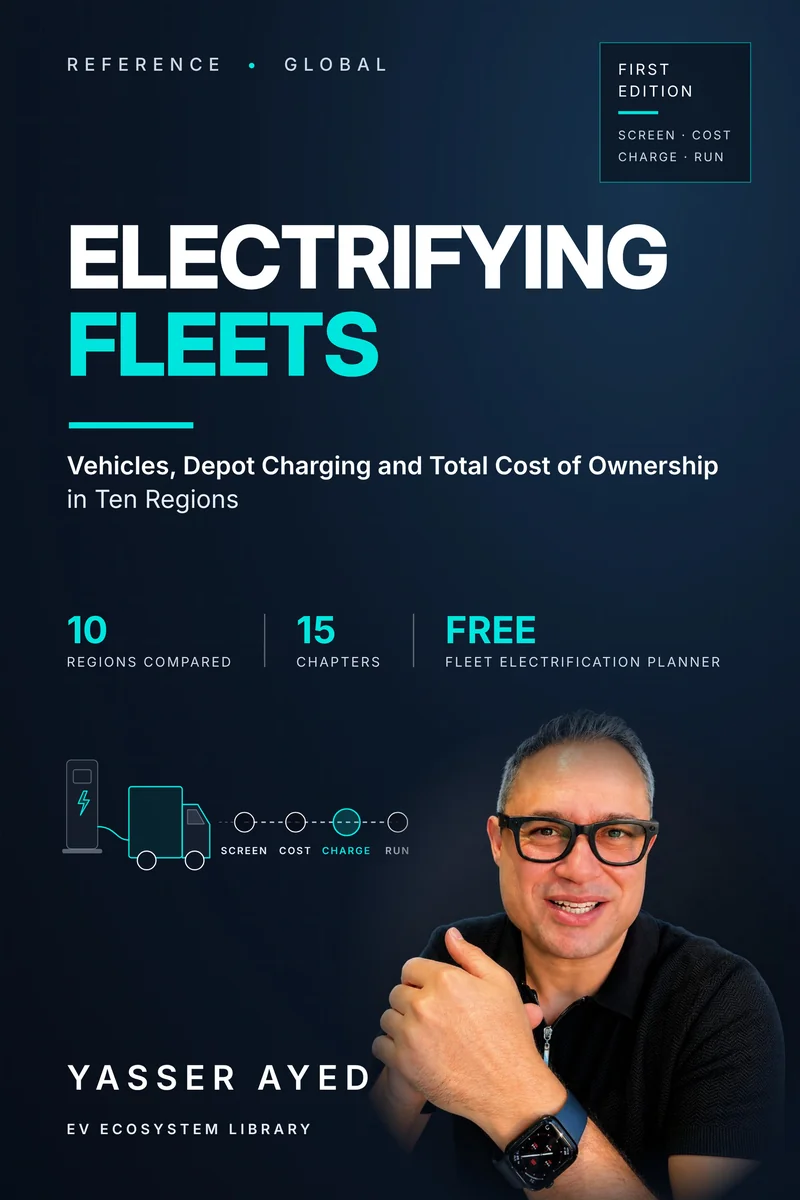
Vehicles, depot charging and total cost of ownership in ten regions. A fleet does not go electric in one decision. It goes one vehicle, one route and one depot at a time, and each step raises a question the brochure does not answer: which routes can go now, whether the total cost still beats diesel once chargers and the grid connection are paid for, and what the battery is worth after five years. This plain-language reference answers them for every kind of fleet, with every rule and incentive dated and sourced. The tables, calculators and roadmap are gathered in a free Fleet Electrification Planner, updated as rules, incentives and tariffs are checked.
Look inside
Who it's for
You already know your routes and what you spend on diesel or petrol. You may not yet know how to turn a duty cycle into a battery size and a charger count, why a depot needs a grid study before anyone orders a charger, what a demand charge does to the total cost of ownership, or what an electric truck's battery is worth at resale. By the end of the book you will. It is not written for private car drivers or vehicle engineers, and it is not financial, tax, legal or electrical-design advice.
At delivery, logistics, utility, municipal, school-bus, public-transport and mining operators, and ride-hailing, taxi, rental and leasing firms.
Who need a total cost of ownership that counts chargers, the connection, demand charges and resale, and a tender that holds up.
Charge point operators, installers, dealers and importers of electric vans, trucks, buses and two- and three-wheelers.
Who plan, fund or judge a fleet transition without running the depot themselves.
What's inside
Plus the ten-region fleet tables, the TCO worksheet in print, a standards and rules index, the acronyms and the fleet terms. Every kind of fleet, from delivery two- and three-wheelers and taxis to vans, rigid trucks, tractor units, city buses, coaches and school buses. Ten regions, always in alphabetical order so none is ranked first: Africa, Australia and New Zealand, China, the European Union, India, Latin America, the Middle East, North America, Southeast Asia and the United Kingdom. Every rule, incentive and figure is dated and sourced, and the sources page has the full links. Where no public data was found, the book says so instead of guessing.
Where the market stands segment by segment, the three pushes (rules, running cost, customers and lenders), the three brakes, rules and incentives in each region, and the push and brake checklist.
What a duty cycle is, the fleet segments from two-wheelers to coaches, energy per kilometre, weather and the worst day, dwell time, where the data comes from, and the duty-cycle data sheet.
The five fits (energy, dwell, payload, availability and cost), turning amber into green, when battery-electric is not yet the answer, and the screen region by region.
The TCO stack, per year and per km, the whole tariff, chargers and the connection, incentives, residual value, downtime, what published studies found, eight assumptions to find in any study, and the sensitivity check.
The charging window, AC or DC, how many chargers, power sharing, managed charging as a sizing tool, depot or opportunity charging for buses, MCS for trucks, battery swapping, the depot layout and the charger sizer.
Who you are talking to, what the utility needs, how the process runs, phasing the fleet around the connection, flexible connections, who pays for reinforcement, bridges, and the connection request pack.
The anatomy of a commercial bill, why the demand charge can matter more than the price per kWh, fleet tariffs, energy cost per kilometre, smart charging, flexibility income, and ten tariff questions.
The location mix, taxis and ride-hailing on public charging, the fleet's side of a charging contract, reliability, fleet cards, trucks en route, home charging for take-home vehicles and swap networks.
Start from the screen, the specs that matter, battery warranties line by line, durability rules, approvals, data access, where vehicles come from, judging a maker from any country, and the offer comparison sheet.
The fleet lines of a charger specification, approvals, funding conditions, uptime and service clauses, dated charger costs, the software, when a supplier fails, and the tender from request to acceptance.
Four risks to place, the ownership models, bus contracting, battery leasing, charging as a service, what a lessor prices, tax and allowances, public and development finance, and the ownership model chooser.
The daily loop, the measures to watch, drivers, heat and cold, technicians and high-voltage awareness, depot fire planning, battery storage, the depot safety plan and the daily charging checklist.
What changes in maintenance, battery health in fleet duty, warranty terms, durability rules, the battery health log, state-of-health evidence at resale, residual value and end of life.
Africa, Australia and New Zealand, China, the European Union, India, Latin America, the Middle East, North America, Southeast Asia and the United Kingdom, each on the same twelve-row template.
Phases over one to five years, the 12-month roadmap, why the utility letter goes out first, governance and KPIs, the risk register, public plans by region and the one-page board summary.
Appendix A: the twelve at-a-glance rows from Chapter 14, one row per region.
Appendix B: the Chapter 4 worksheet as a fill-in page, with an illustrative worked example.
Appendix C: every main standard, rule and programme named, with its edition or date at the time of writing.
Appendices D and E: the acronyms, and the fleet terms this book adds to the library glossary.
Free Fleet Electrification Planner
The book gives the method and dated examples. The Planner turns the method into your own numbers and keeps the fastest-changing facts, rules, incentives, tariffs and connection facts for ten regions, in one place, updated as they are checked. It's free for readers: one spreadsheet and one printable PDF. Enter your email and the download links appear right away.
The links are private and expire after one hour. Come back and submit the form again any time for fresh links. You'll hear by email when the Planner is updated.
Rules, incentives, tariffs and deadlines change often. Confirm the current position with the regulator, your utility and your advisers before you buy, build or sign. The Planner is for information, not financial, tax, legal or electrical-design advice, and its total cost of ownership results are only as good as the figures you enter. The book's sources, with full links, are on the Notes and Sources page.
Editions

About the author
Yasser Ayed is an entrepreneur and the founder of KEEL, an EV charging infrastructure company operating across the Middle East. Based in Shenzhen, China, he works at the intersection of technology, manufacturing and the Middle East. He has more than 15 years of experience building businesses across the UAE, the United States and China. He writes the EV Ecosystem Library, practical field guides for people who buy, build and invest in electric mobility, starting with the Shenzhen EV Sourcing Playbook and The Business of EV Charging.
EV Ecosystem Library
Each book stands on its own. Together they take you from the show floor and the factory to a charging site that pays back.
Field guide · Sourcing
Find, vet and buy from Chinese EV charger, storage and power-technology factories.
Field guide · EV charging
How charging sites make money, where they lose it, and whether to invest.

Field guide · Trade shows
Choose the right shows, work the floor and come home with a supplier shortlist.
Business guide · China EV
How China builds electric mobility and how its brands are going global.

Practical guide · Property charging
Add chargers to apartment buildings, offices, hotels and retail sites, anywhere in the world, without being sold to.

Business reference · Batteries
Read a battery datasheet, compare warranties, check the safety proof and buy EV and storage batteries from China safely.
Reference · Charging standards
Connectors, power levels, standards and networks in plain language, with every standard named by number and ten regions compared.
Reference · Certification
The marks, tests and approvals chargers and batteries need in ten regions, how one CB report can serve many markets, and how to check a certificate.
Reference · Networks
Keep every charger working, paid for and reported: uptime, the CPMS, field service, prices, payments, roaming and reporting, in ten regions.
Reference · Charger brands
Put your own name on the charger and stand behind it: the route, spec, maker, contract, firmware, approvals and after-sales, in ten regions.
Reference · Installers
Run the business side of charger installation: licences, survey and quote, pricing, crews, the utility, contracts, SLAs and cash, in ten regions.
Electrifying FleetsPDF + Fleet Electrification Planner, instant download
Buy · $15