Field guide · Sourcing
Shenzhen EV Sourcing Playbook
Find, vet and buy from Chinese EV charger, storage and power-technology factories.
EV Ecosystem Library · Reference · Charging standards
A global guide to connectors, power levels, standards and networks. Charging looks simple from the car park: a cable, a plug, a screen and a price. Behind it sit a chain of standards, three conversations between machines and rules that change at every border. Learn the words once, in plain language, with every standard named by number and practice compared across ten regions. The book's dated entries for ten regions are gathered in a free Charging Standards Map, updated as rules are checked.
Look inside
Who it's for
You know what an EV is and roughly how a kilowatt differs from a kilowatt-hour. You do not yet need to know Mode 3 from Level 2, CCS1 from CCS2, or OCPP 1.6 from 2.0.1. By the end of the book you will. It is a plain-language reference, not a driver's guide, an installation manual or an exhaustive engineering or legal reference for every country.
Who commission, run and fix chargers and need the words for connectors, protocols and back ends from day one.
Sales, product and export teams, including Chinese makers, who must offer the right connector, protocol and payment set for each market.
Who read spec sheets and tenders line by line and need to know what "OCPP compliant" or "150 kW" really promises.
Property, fleet and facility managers, utility, regulator and city staff, investors and analysts who judge charging proposals without designing chargers.
What's inside
Plus the library glossary, a standards index by number and edition, and the acronyms. Ten regions are compared and none is the frame: North America, the EU, the UK, China and East Asia, India, Southeast Asia, the Middle East, Latin America, Africa, and Australia and New Zealand. Every figure is dated and sourced, and the sources page has the full links. Where no official source was found, the book says so instead of guessing.
Power and energy, kW and kWh, where charging happens, why the car decides how fast it charges, the battery management system, losses between grid and battery, and four words for the hardware.
Two places to convert, the on-board charger's AC limit, the control pilot and proximity signals, Mode 2 cables, DC fault protection, losses, and an AC or DC decision tree.
The IEC's modes and North America's levels side by side, the power ladder, how the supply sets the AC ceiling, why the book gives kW instead of speed words, and where Mode 1 and Mode 2 are restricted.
Plugs, inlets and couplers, the IEC 62196 family, AC and DC connectors, the ten-region connector map, light-EV connectors, what adapters can and cannot fix, and building the right connector for a market.
The AC wallbox, the DC cabinet and its power modules, all-in-one or split, cables and cooling, IP, IK and heat, cybersecurity as a hardware question, the product standards and a component checklist.
The three layers of every conversation, the pilot on AC, the three DC protocol families, what the messages carry, Plug and Charge, what the rules ask for, when it fails, and the readiness questions.
What OCPP does, versions 1.6, 2.0.1 and 2.1, why "OCPP compliant" is not enough, security, other back-end and grid protocols, China's back end, rules that require open protocols, and OCPP lines for a tender.
Ways to start a session, the rules on ad hoc payment and price display, roaming with OCPI and OICP, charger and contract IDs, tariffs as data, open data, metering for trade, and payment lines for a spec.
Why the lowest limit wins, the charging curve, voltage, current and the cable, hot chargers and cold batteries, sharing between outlets, a real session, and the "Why is it slow?" diagnostic.
The connection as the ceiling, who approves it, load management and smart charging, the signal chain, where rules require smart capability, power quality, storage-buffered chargers and five grid facts for a spec.
Four words for four measures, how rules measure uptime, why uptime is not a successful charge, why charging fails, what a buyer can specify, and the uptime definitions sheet.
The eight blocks and thirty lines that matter, red flags, checking a sheet against your region's rules, a worked example, reading and answering a tender, and the supplier question list.
How to read the map, the ten regions in brief, and what changes fastest. Every entry is dated, and the map says "No public data found" where no official source was found.
The maturity ladder, bidirectional charging from V2L to V2G, battery swapping, megawatt charging for trucks, wireless charging, pantographs and robots, where each region stands, and the maturity check.
Free Charging Standards Map
The book gives you the system and dated examples. The facts that change fastest, each region's connector, protocol, payment, metering and uptime rules, standard editions and public charger counts, are dated in print. The map gathers the book's dated entries in one place and is updated as rules are checked. It's free for readers: one spreadsheet and one printable PDF. Enter your email and the download links appear right away.
The glossary is open to everyone: search the library glossary.
The links are private and expire after one hour. Come back and submit the form again any time for fresh links. You'll hear by email when the map is updated.
Standards, editions, rules and charger counts change often. Always check the issuing body or the official source before you rely on them. The map is for information, not engineering, electrical-installation, legal or certification advice. The book's sources, with full links, are on the Notes and Sources page.
Editions

About the author
Yasser Ayed is an entrepreneur and the founder of KEEL, an EV charging infrastructure company operating across the Middle East. Based in Shenzhen, China, he works at the intersection of technology, manufacturing and the Middle East. He has more than 15 years of experience building businesses across the UAE, the United States and China. He writes the EV Ecosystem Library, practical field guides for people who buy, build and invest in electric mobility, starting with the Shenzhen EV Sourcing Playbook and The Business of EV Charging.
EV Ecosystem Library
Each book stands on its own. Together they take you from the show floor and the factory to a charging site that pays back.
Field guide · Sourcing
Find, vet and buy from Chinese EV charger, storage and power-technology factories.
Field guide · EV charging
How charging sites make money, where they lose it, and whether to invest.
Field guide · Trade shows
Choose the right shows, work the floor and come home with a supplier shortlist.
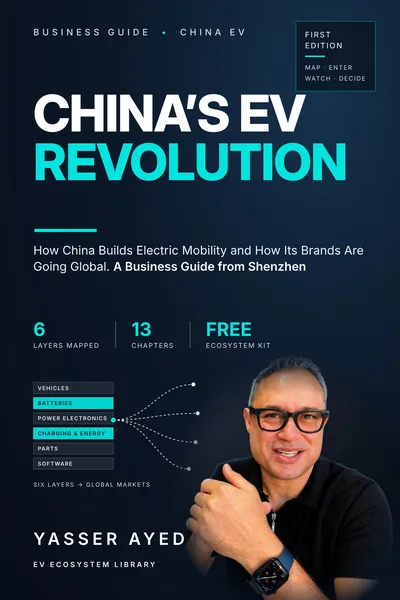
Business guide · China EV
How China builds electric mobility and how its brands are going global.
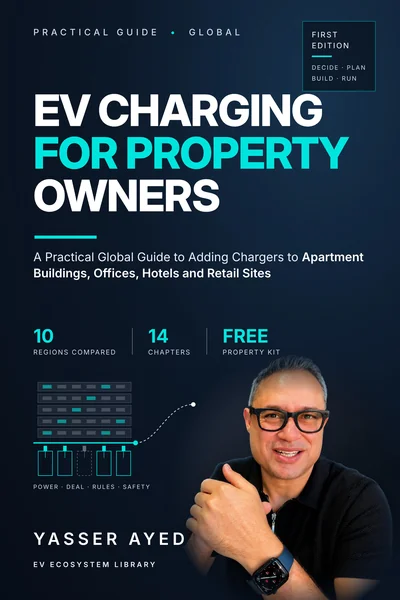
Practical guide · Property charging
Add chargers to apartment buildings, offices, hotels and retail sites, anywhere in the world, without being sold to.
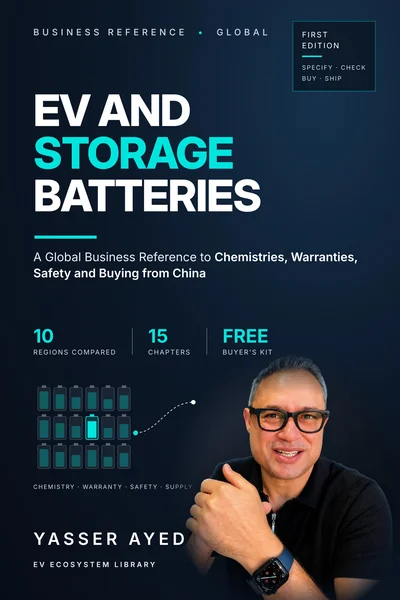
Business reference · Batteries
Read a battery datasheet, compare warranties, check the safety proof and buy EV and storage batteries from China safely.
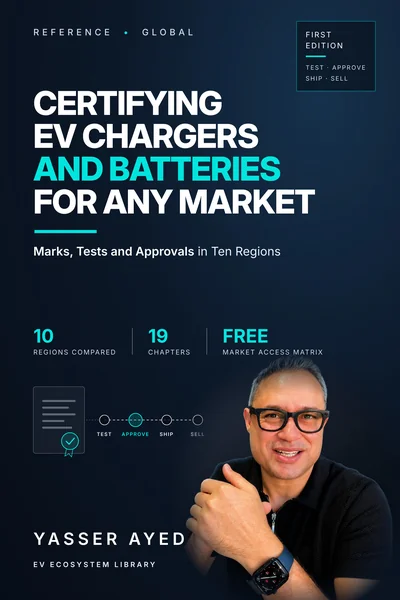
Reference · Certification
The marks, tests and approvals chargers and batteries need in ten regions, how one CB report can serve many markets, and how to check a certificate.
Reference · Fleets
Which vehicles to switch first, a total cost of ownership your finance team trusts, depot charging and the grid connection, in ten regions.
Reference · Networks
Keep every charger working, paid for and reported: uptime, the CPMS, field service, prices, payments, roaming and reporting, in ten regions.
Reference · Charger brands
Put your own name on the charger and stand behind it: the route, spec, maker, contract, firmware, approvals and after-sales, in ten regions.
Reference · Installers
Run the business side of charger installation: licences, survey and quote, pricing, crews, the utility, contracts, SLAs and cash, in ten regions.
How EV Charging WorksPDF + Charging Standards Map, instant download
Buy · $15