
Field guide · Sourcing
Shenzhen EV Sourcing Playbook
Find, vet and buy from Chinese EV charger, storage and power-technology factories.
EV Ecosystem Library · Reference · Networks
Uptime, software, payments and field service in ten regions. A charging network is built in months and run for years, and the running decides whether drivers come back and whether the network pays. Why does a dashboard that says 98% uptime sit beside one-star reviews? What should the maintenance contract say? What does the regulator want reported, and what changes at 200 sites? This plain-language reference answers them for operators anywhere, with every rule and figure dated and sourced. The live rules tables, KPI dashboard and runbooks are gathered in a free Network Operations Kit, updated as the rules are checked.
Look inside
Who it's for
You built or bought your sites. You may not yet know how to write a service level agreement that holds a contractor to account, why 99% uptime can sit beside a much lower charging success rate, or what your region's rules require you to report. By the end of the book you will. It is not written for drivers or charger designers, and it is not legal, financial, tax, payments or electrical-design advice.
From five chargers to thousands: the operations, field service, pricing, payment and roaming teams who keep a network working and paid.
Running their own chargers beside another business, and answerable to drivers and the regulator for them.
Maintenance contractors after O&M contracts, CPMS, payment and charger vendors, and importers who end up supporting the networks that bought their chargers.
Who fund or buy networks and need uptime figures, KPIs and due diligence they can trust.
What's inside
Plus the ten-region operating tables, SLA, KPI and runbook templates in print, a standards and rules index, the acronyms and the network operations terms. Every kind of public network, from kerbside and destination AC chargers to DC fast hubs, highway corridors, fuel forecourts, utility, municipal and car-maker networks, and two- and three-wheeler charging and battery swapping. Ten regions, always in alphabetical order so none is ranked first: Africa, Australia and New Zealand, China, the European Union, India, Latin America, the Middle East, North America, Southeast Asia and the United Kingdom. Every rule, standard and figure is dated and sourced, and the sources page has the full links. Where no official source was found, the book says so instead of guessing.
Twelve jobs that keep a network working and paid, the roles, what to own, outsource or share, who the law holds responsible, how the daily work differs by network type, what changes with size, and the responsibility map.
The layers, the seams and who answers when they fail, connectivity as a layer, the identifiers that must stay stable, the data you must own, the rules that reach each layer, and the stack map.
Start from operations, not the demo: requirements in ten groups, the procurement, the platform contract, running the platform, switching without losing data, when a vendor fails, and China's different model.
Four words that get reused, the measures built on them, the rules as written, why the numbers differ, root causes, standard error codes, internal targets above the rule, and reliability rules by region.
What the back end can see, the alarms that matter, severity by driver impact, the remote-fix ladder, silent failures, the ticket flow and its timestamps, running the operations centre, and the status others see.
Preventive and corrective maintenance, the O&M contract and an SLA clock your contractor cannot pause, tiered support, technician qualifications, spares, warranty and returns, and what to do when the maker fails.
The firmware and configuration register, update rings and rollback, signed firmware, configuration drift, OCPP security profiles and certificates, Plug and Charge certificates, incidents, and session data as personal data.
A tariff is data, display and unit rules, ceilings and floors, idle and overstay fees, changing a price during a session, member, fleet and partner prices, the price change runbook, and why apps show the wrong price.
Every way a session starts, the ad hoc payment rules, payment rails, card security at unattended terminals, refunds and chargebacks, Plug and Charge, fleet tokens, roaming partners and settlement.
The bill at a charging site, tariffs built for charging, the tariff register and the bill check, site power limits, smart-charging rules, supply contracts, renewable sourcing, flexibility and swap stations.
What drivers report, the helpline and contact duty, what the support desk must be able to do, on-site information, accessibility, complaints, refunds and disputes, privacy, and support data as a fault source.
Four kinds of duty, licence and registration conditions, data and publication duties, metering for trade, funding conditions, penalties as patterns, exclusions that need evidence, and the compliance calendar.
The operating KPI set, KPIs set by rules and public programmes, why uptime alone misleads, the KPI tree, checking the data first, the monthly review on one page, and KPIs for investors and lenders.
What breaks at each stage, site onboarding, one short list of hardware and spares, team and contractors, the data lenders ask for, buying and selling networks, technical due diligence and the first 100 days.
Africa, Australia and New Zealand, China, the European Union, India, Latin America, the Middle East, North America, Southeast Asia and the United Kingdom, each on the same layout.
Measure the baseline, fix the largest losses, make it routine: three phases on one page, the risk register, calendars and public help by region, the one-page board summary and when to call whom.
Appendix A: the twelve at-a-glance rows from Chapter 15, one row per region.
Appendix B: the SLA clock, ten O&M clauses, KPI formulas, the fault-to-fix and price change runbooks, and an illustrative worked example.
Appendix C: every main standard, rule and programme named, with its edition or date at the time of writing.
Appendices D and E: the acronyms, and the operating terms this book adds to the library glossary.
Free Network Operations Kit
The book gives the method and dated examples. The Kit turns the method into your own dashboard, contracts and runbooks, and keeps the fastest-changing operating rules for ten regions current, in one place. It's free for readers: one spreadsheet and one printable PDF. Enter your email and the download links appear right away.
The links are private and expire after one hour. Come back and submit the form again any time for fresh links. You'll hear by email when the Kit is updated.
Rules, fees, thresholds and deadlines change often. Confirm the current position with the regulator, your utility, your payment provider and your advisers before you change how you operate or sign a contract. The Kit is for information, not legal, financial, tax, payments or electrical-design advice, and its worked SLA penalties and KPI figures are illustrative, never targets. The book's sources, with full links, are on the Notes and Sources page.
Editions

About the author
Yasser Ayed is an entrepreneur and the founder of KEEL, an EV charging infrastructure company operating across the Middle East. Based in Shenzhen, China, he works at the intersection of technology, manufacturing and the Middle East. He has more than 15 years of experience building businesses across the UAE, the United States and China. He writes the EV Ecosystem Library, practical field guides for people who buy, build and invest in electric mobility, starting with the Shenzhen EV Sourcing Playbook and The Business of EV Charging.
EV Ecosystem Library
Each book stands on its own. Together they take you from the show floor and the factory to a charging site that pays back.
Field guide · Sourcing
Find, vet and buy from Chinese EV charger, storage and power-technology factories.
Field guide · EV charging
How charging sites make money, where they lose it, and whether to invest.

Field guide · Trade shows
Choose the right shows, work the floor and come home with a supplier shortlist.
Business guide · China EV
How China builds electric mobility and how its brands are going global.
Practical guide · Property charging
Add chargers to apartment buildings, offices, hotels and retail sites, anywhere in the world, without being sold to.

Business reference · Batteries
Read a battery datasheet, compare warranties, check the safety proof and buy EV and storage batteries from China safely.
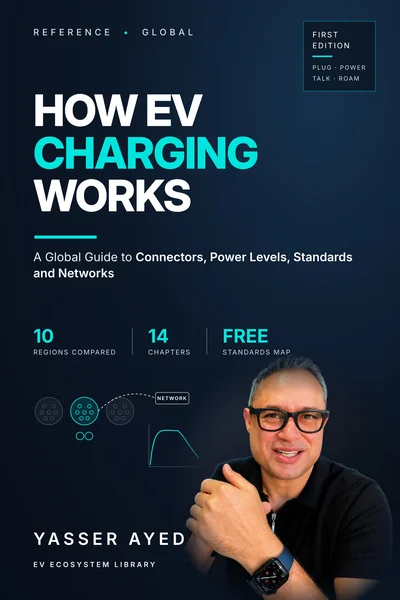
Reference · Charging standards
Connectors, power levels, standards and networks in plain language, with every standard named by number and ten regions compared.
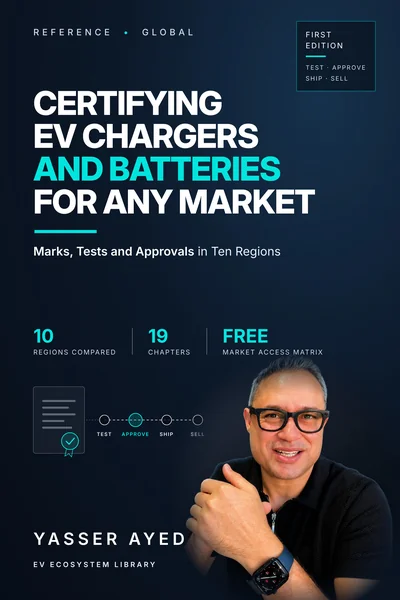
Reference · Certification
The marks, tests and approvals chargers and batteries need in ten regions, how one CB report can serve many markets, and how to check a certificate.
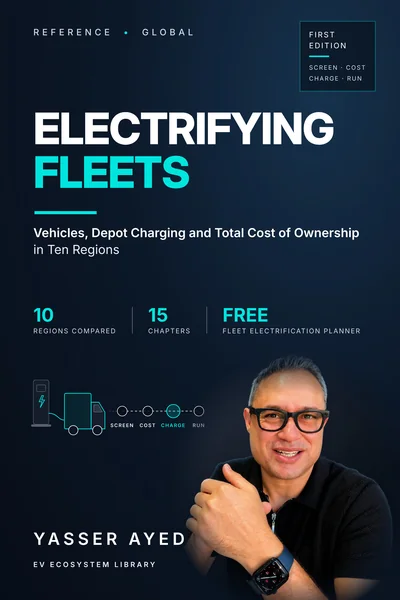
Reference · Fleets
Which vehicles to switch first, a total cost of ownership your finance team trusts, depot charging and the grid connection, in ten regions.
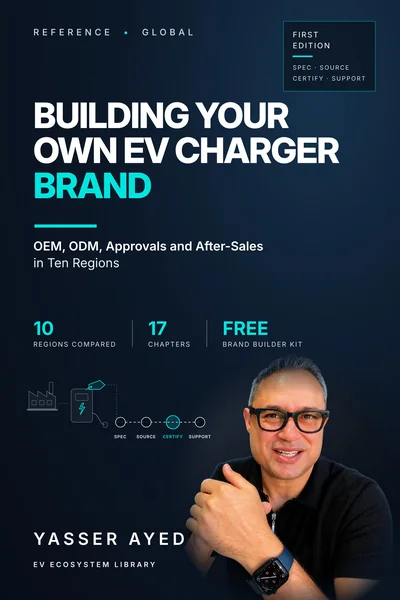
Reference · Charger brands
Put your own name on the charger and stand behind it: the route, spec, maker, contract, firmware, approvals and after-sales, in ten regions.
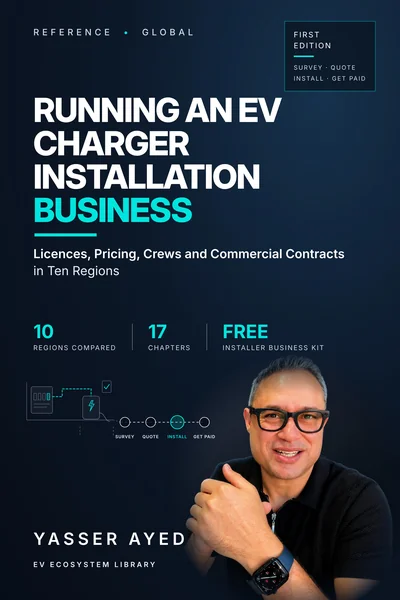
Reference · Installers
Run the business side of charger installation: licences, survey and quote, pricing, crews, the utility, contracts, SLAs and cash, in ten regions.
Running an EV Charging NetworkPDF + Network Operations Kit, instant download
Buy · $15